


 Video Generation Types
 Supported AI Models
 AI Video Effects



 AI Video Tools
 AI Music Tools
 AI Voiceover Tools
 More Features
 API for Music-related Services
 API for Voiceover-related Services

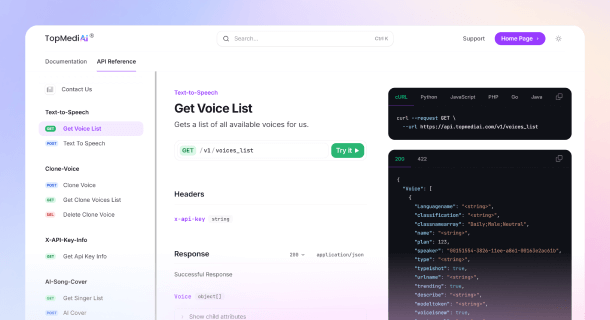
 TopMediai's API Documentation:
 Help&Support
 Popular Tips


 Join our Discord!

 AI Video Generator


OpenAI has just launched Sora 2.0, the latest AI video generator that turns text into realistic, cinematic clips. With improved motion, longer video length, and enhanced fidelity, Sora 2 AI video generator opens new possibilities for creators. This article covers everything you need to know about Sora 2.0, including its features, improvements, limitations, and using Sora 2 online, so you can start exploring AI video creation with confidence.

- Part 1: Use Sora 2.0 Online – No Code, No Download Needed
- Part 2: Everything You Need to Know About Sora 2.0
- 1. What Is Sora 2.0?
- 2. How Does Sora 2.0 Work?
- 3. Sora 2.0 vs Sora 1.0: What’s New?
- 4. Limitations of Sora 2.0
- Part 3: FAQs about Sora 2.0
Part 1: Use Sora 2.0 Online – No Code, No Download Needed
1 TopMediai AI Video Generator – Support Sora 2.0 Online Creation
If you’re looking for a Sora 2 online with no code that works entirely online and supports advanced AI video generation, TopMediai AI Video Generator is a reliable choice. The platform has officially integrated OpenAI’s Sora 2.0 model, enabling users to create high-quality, cinematic videos directly in their browser — no installation or downloads required.
TopMediai also supports Nano banana raw images, allowing users to generate AI images first and then seamlessly turn them into animated Veo 3-powered videos. This unified workflow — from image creation to video production — helps creators easily transform a single AI-generated image into a fully polished animated clip. Combined with text-to-video capabilities, TopMediai is perfect for social media content, YouTube intros, storytelling videos, or personal creative projects.

How to Use Sora 2.0 online with no code:
Step 1: Visit Image-to-Video or Text-to-Video dashboard on TopMediai.
Secure Visit
Step 2: Select “Sora 2.0 Model” from the model options.
Step 3: Enter your text prompt or upload an image. Then select the resolution, duration, and aspect ratio.
Step 4: Click "Generate", and AI will generate a smooth, high-quality video for you.
Step 5: Preview and then download or share your video generated using Sora 2.

Veo 3-powered AI generation for realistic video output.
One-stop Nano banana workflow: generate images and immediately convert them into videos.
Image-to-video and text-to-video conversion from prompts or AI images.
Multiple styles including Cinematic, Chibi, Cyberpunk, and Vintage.
Built-in AI music generator for background tracks.
TTS voiceover support for natural AI speech.
Fast online rendering, no downloads needed.
User-friendly interface suitable for beginners and professionals.
- Complete online workflow with no installation needed.
- Seamless transition from AI images to fully animated videos.
- High-quality animations with smooth motion and cinematic transitions.
- 100+ video effects for creative flexibility.
- Integrated music and voiceover options.
- Beginner-friendly interface with intuitive controls.
- Advanced features need careful prompts.
- Requires stable internet connection.
Part 2: Everything You Need to Know About Sora 2.0
1 What Is Sora 2.0?
Sora 2.0 is widely expected to be the next evolution of OpenAI’s text-to-video system, following the groundbreaking release of the original Sora model in early 2024. The first version of Sora amazed the world with its ability to generate realistic short videos directly from written text, marking a major milestone in generative AI.
Users can join the waitlist directly within the app and receive an invite notification once access opens for their account. OpenAI has confirmed that Sora 2 will initially be available for free, with generous limits during the rollout phase. For advanced users, ChatGPT Pro members will gain access to the experimental, higher-quality Sora 2 Pro model, which will soon be available both on the web and in the Sora app.

Generates longer clips (up to 2–3 minutes) with smooth transitions and consistent storytelling.
Produces 1080p-level videos with realistic lighting, textures, and natural motion.
Understands complex text inputs, including emotional tone, camera movement, and narrative intent.
Can create multiple connected scenes in a single video, ideal for storytelling and film-style projects.
2 How Does Sora 2.0 Work?
At its core, Sora 2.0 relies on a powerful text-to-video diffusion model combined with transformer-based architecture. When you enter a prompt—such as “a cinematic view of a neon city at night”—Sora 2.0 converts it into a visual sequence through multiple stages of motion synthesis, scene construction, and frame interpolation.
The system first predicts the video’s spatial layout, then refines each frame to ensure realistic movement and lighting. Its upgraded contextual understanding allows it to capture fine-grained details, like reflections, textures, and human gestures, producing results that feel almost camera-shot.
Thanks to OpenAI’s optimization, Sora 2.0 also processes inputs faster and with greater consistency, significantly reducing rendering artifacts that appeared in version 1.0. The result is a seamless Sora 2 text to video experience capable of professional-grade output.

3 Sora 2.0 vs Sora 1.0 — What’s New
Sora 2.0 represents a significant evolution from the original version. The table below summarizes the most important updates based on OpenAI’s official rollout details and verified user feedback.
| Feature | Sora 1.0 | Sora 2.0 (New) | Improvement Summary |
|---|---|---|---|
| Video Length | Up to 20 seconds | Up to 60 seconds | Enables longer storytelling and scene continuity |
| Visual Quality | Moderate fidelity, visible artifacts | Sharper, cleaner, higher-resolution frames | Improved rendering and texture detail |
| Temporal Consistency | Occasional flickering or object shifts | Stable motion and object permanence | More consistent characters and scenes |
| Physics Simulation | Basic motion and collision handling | Realistic movement, gravity, and fluid dynamics | More lifelike animations |
| Editing Control | No direct editing | Early support for object replacement and re-renders | Allows targeted scene refinement |
| Speed & Accessibility | Slower rendering, limited access | Faster previews; available via iOS app, sora.com, and API (coming soon) | More user-friendly and accessible |
| Safety Features | Minimal watermarking | Strong watermarking and provenance metadata | Enhanced transparency and content traceability |
| Usage Model | Research access only | Free public rollout (U.S. & Canada first), Pro version available | Wider availability and tiered quality options |
4 Limitations of Sora 2.0
Even with these improvements, Sora 2.0 still faces important technical and ethical limitations. Users and developers should approach it with realistic expectations.
Visual Artifacts and Flicker
Some outputs still show distortion or missing frames, especially in complex motion or detailed textures.
Physics and Motion Errors
While improved, physical realism isn’t perfect — objects may float or behave unnaturally in rare cases.
Bias and Representation
Early Sora versions were reported (e.g., Wired) to exhibit gender and ability bias in generated visuals. OpenAI is working to mitigate this, but residual bias can remain.
Copyright and IP Risk
Generated clips can resemble copyrighted works or recognizable brands, raising legal questions about ownership and use.
Unclear Regulations
Legal frameworks for AI-generated video are still developing globally. Questions of attribution, consent, and liability remain unsettled.
Part 3: FAQs about Sora 2.0
1 How can I access Sora 2.0?
Sora 2.0 can be accessed through the Sora iOS app and the sora.com website. Once users receive an invitation, they can start generating and managing videos directly on these platforms. OpenAI also plans to release an API for developers later.
2 Is Sora 2.0 free to use?
Yes, Sora 2.0 is currently free to use during its early release phase, with generous limits to encourage exploration. However, OpenAI may introduce usage-based pricing later. ChatGPT Pro users can also access Sora 2 Pro, an experimental high-quality version.
3 Does Sora 2.0 support audio generation?
No. Sora 2.0 currently focuses only on video generation. Users must add background sound or dialogue separately using other tools.
4 Can I use Sora 2.0 videos for commercial projects?
OpenAI has not yet finalized commercial licensing for Sora 2.0. Until detailed policies are published, it’s safest to use the generated videos for personal or experimental purposes.
5 Is Sora 2.0 available on Android?
Not yet. Currently, Sora 2.0 is available only for iOS and web users. OpenAI has not announced an Android release timeline.
You May Also Like:
Best AI Monster Video Generators for Realistic Monster Videos
Create Zombie AI Videos with the Best AI Zombie Video Generators [2026]
Conclusion Creating a Sora 2.0 marks an important advancement in AI video generation, delivering longer clips, higher fidelity, and smoother animations than its predecessor. While some technical and ethical considerations remain, it offers creators an accessible way to experiment and produce engaging content. For those looking for a flexible, fully online option, tools like TopMediai AI Video Generator provide a simple path from AI-generated images to animated videos. Start exploring these AI-powered tools today and bring your creative ideas to life.
Secure Visit

-

February 24, 2026
TopMediai Coupon Code: Save on All AI Tools with One Plan -

January 29, 2026
Super Bowl AI Voice: Create Viral Game-Day Content -

January 26, 2026
Best Santa Video for Kids in 2026: Create Magical Christmas Messages -

January 26, 2026
How to Use Grok Imagine: Free Tutorials & Best Alternatives -

January 26, 2026
Best 5 AI News Generators to Produce News Articles & Videos
Recent Blogs


